Service 07 / 08
App development
Building a mobile app turns a repeated action of your clients — booking, ordering, tracking — into a tool they keep in their pocket. iOS and Android, from a real business need, not a trend.
Why
An app isn’t a smaller website: it’s a shortcut to an action your clients repeat. Booking a slot, ordering again, tracking a case — if that use exists in your business, an app makes it simpler, faster, and settles you durably on your clients’ home screen.
Conversely, an app with no repeated use dies in three weeks: downloaded, opened twice, forgotten. That’s why Giulo Création starts with the awkward question — “what will your clients do again every week?” — and advises against the app if the answer is vague.
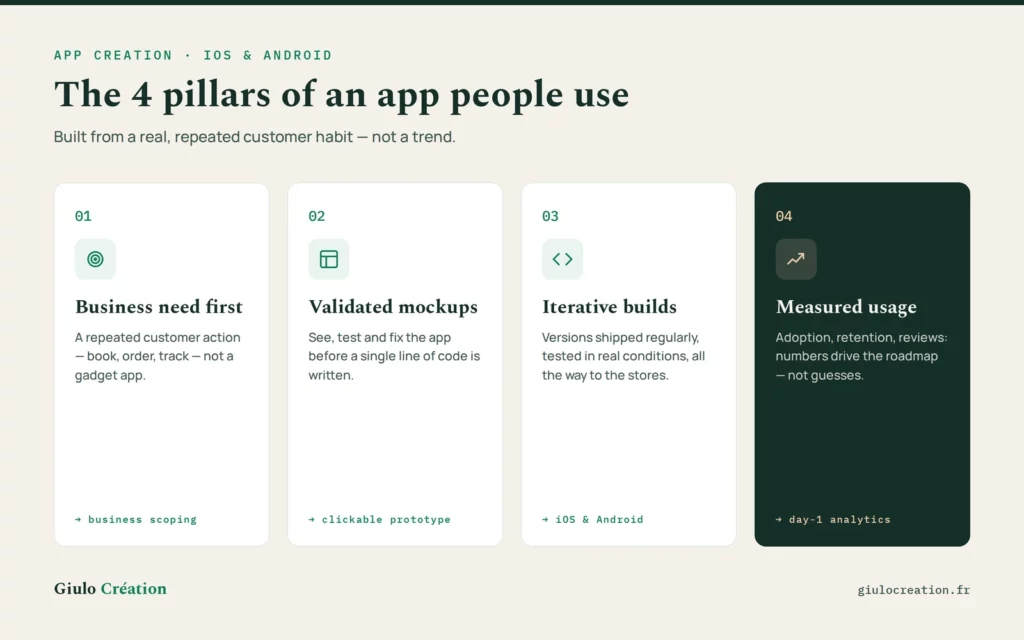
When the need is real, the method secures the budget: clickable mockups approved before any development, versions delivered continuously, guided publication on the App Store and Google Play, and usage measured from launch.
Deliverables
From product framing to deployment, with short one-to-two-week sprints to iterate fast.
- Business scopingThe core use, the users, the essential features — and those we won’t do in V1. The scope is written, the budget too.
- Clickable UX/UI mockupsYou test the app with your finger before a single line of code exists. Fixes here cost ten times less than in development.
- iOS and Android developmentVersions delivered regularly, testable on your phone. You follow progress in real conditions, not on a schedule.
- Testing and QACritical paths verified, edge cases handled, performance checked before publication. An app that crashes can’t be caught up in the reviews.
- Publication on the storesApp Store and Google Play listings, visuals, compliance, submission and review tracking. You go live cleanly, under your account.
- Post-launch monitoringAdoption, retention, reviews and crashes, tracked from day one. V2 evolutions come from usage figures, not assumptions.
Method
The Giulo Method
-
01
Diagnosis
The repeated use, the users, the existing tech. If the app isn’t the right tool, you’ll know before paying for development.
-
02
ROI prioritisation
A V1 focused on the core use: every added feature must justify itself by expected usage.
-
03
Delivery
Mockups, testable versions, store publication: concrete milestones, on your phone.
-
04
Measurement
Downloads, retention, reviews. The V2 roadmap is decided on these figures.
Proof
4 to Play padel
Mobile app dedicated to padel, built for iOS and Android.
Learn more →Frequently asked questions
How is this different from a website?
Do I need an MVP before investing?
Native or web app?
Do you also handle hosting?
What do I keep after delivery?
How much does a mobile app cost?
iOS, Android, or both?
How long to develop an app?
Native app or web app (PWA)?
Who owns the app and the code?
Thirty minutes, no jargon.
A free, no-commitment audit: what’s working, what’s leaking, and an action plan ranked by ROI. Reply within 24 hours.